
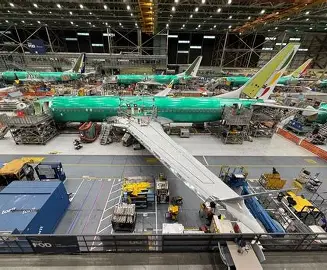
Boeing is set to begin producing 737 Max aircraft on a new assembly line starting July 6, according to company leadership. The move is part of Boeing’s efforts to increase manufacturing capacity, improve production efficiency, and meet growing demand from airline customers.
The expansion reflects the company’s focus on strengthening operations and supporting future growth in the commercial aviation market. Industry analysts say the additional production capacity could help Boeing accelerate aircraft deliveries and improve business performance in the coming years.
Boeing is preparing to take another step in strengthening its commercial aircraft production as it plans to begin operations on a new 737 Max assembly line starting July 6. The announcement, shared by company leadership, comes at a time when demand for new aircraft remains strong across the global aviation industry.
The decision to expand production capacity is closely linked to Boeing’s broader effort to improve efficiency and stabilize its manufacturing operations. In recent years, aircraft manufacturers have faced pressure to meet rising airline demand while also dealing with supply chain challenges and production delays. Adding a new assembly line is seen as one way to help address these issues and increase overall output.
The 737 Max program remains one of Boeing’s most important product lines, widely used by airlines for short and medium-haul routes. Because of its efficiency and range, the aircraft continues to attract strong interest from carriers looking to modernize their fleets and replace older models. As global air travel continues to recover and expand, demand for narrow-body aircraft like the 737 Max is expected to remain steady.
By launching a new assembly line, Boeing aims to increase its production capacity and reduce bottlenecks in the manufacturing process. This expansion is not only about producing more aircraft but also about improving the flow of production. A more efficient system can help the company deliver planes faster, which is a key concern for airline customers that often face long waiting times for new aircraft deliveries.
Industry observers note that this move reflects Boeing’s focus on strengthening its operational performance. In the highly competitive aerospace market, manufacturers are under constant pressure to improve delivery timelines, maintain quality standards, and manage costs effectively. Expanding production facilities is one of the ways Boeing is working to stay competitive and meet long-term demand.
Airlines around the world are currently in a phase of fleet renewal. Many are replacing older aircraft with newer, more fuel-efficient models to reduce operating costs and meet environmental standards. The 737 Max plays a central role in this transition, making its production capacity a critical factor for both Boeing and its customers.
At the same time, the broader aviation industry is experiencing a steady increase in passenger demand. As more people travel for business and leisure, airlines are expanding routes and increasing flight frequencies. This naturally creates additional demand for aircraft, further supporting Boeing’s decision to scale up production.
However, increasing production capacity in the aerospace industry is not a simple process. It requires careful coordination across suppliers, engineers, and manufacturing teams. Any disruption in the supply chain can affect production timelines, making efficiency and planning extremely important. Boeing’s ability to manage these challenges will play a key role in determining how successful the new assembly line will be.
Despite these challenges, analysts believe the expansion could have a positive impact on Boeing’s long-term performance. Higher production rates could lead to improved aircraft deliveries, stronger customer relationships, and better financial results over time. It also signals confidence in sustained demand for commercial aviation in the coming years.
Looking ahead, Boeing’s focus will likely remain on balancing production growth with operational stability. As the company continues to scale up, maintaining quality and reliability will be just as important as increasing output. The success of the new 737 Max assembly line could become an important factor in shaping Boeing’s position in the global aerospace market.
In conclusion, the launch of a new 737 Max assembly line represents a strategic move by Boeing to strengthen its production capabilities and meet growing airline demand. With the aviation industry continuing to expand, this development highlights the company’s efforts to improve efficiency, increase deliveries, and support long-term growth.