
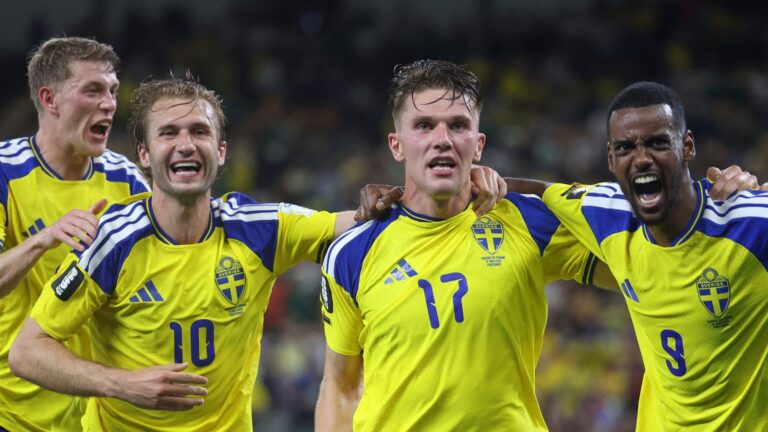
Sweden made a powerful statement at the 2026 FIFA World Cup with an emphatic 5-1 victory over Tunisia in their opening Group F encounter. In a match filled with attacking football, clinical finishing, and moments of individual brilliance, Sweden demonstrated why many observers consider them one of the tournament’s potential surprise packages.
The Scandinavian side entered the competition carrying high expectations after a strong qualifying campaign and a renewed sense of confidence under manager Graham Potter. Facing a determined Tunisian team known for its defensive discipline, Sweden knew they would need to be at their best to begin their World Cup journey with three points.
From the opening whistle, Sweden looked sharp and aggressive. Their midfield controlled possession, while the attacking partnership of Viktor Gyokeres and Alexander Isak immediately caused problems for Tunisia’s back line. The pair combined effectively, using movement, pace, and intelligent positioning to stretch the African side’s defense.
Sweden’s early pressure eventually paid off when Gyokeres opened the scoring. After a well-worked move through midfield, the striker found space inside the penalty area and calmly finished past the Tunisian goalkeeper. The goal settled Swedish nerves and gave the team confidence to push forward in search of additional goals.
Tunisia attempted to respond quickly and showed flashes of quality during the first half. Their midfielders worked hard to disrupt Sweden’s rhythm, and several promising attacks suggested they could get back into the contest. However, Sweden’s defense remained organized and disciplined, limiting the number of clear opportunities available to their opponents.
As the match progressed, Alexander Isak began to influence the game more heavily. The forward’s technical ability and creativity allowed Sweden to maintain constant attacking pressure. Shortly before halftime, Isak played a crucial role in Sweden’s second goal, either by creating space for a teammate or providing the final pass that unlocked Tunisia’s defense. The two-goal advantage gave Sweden firm control heading into the break.
The second half started in dramatic fashion. Tunisia emerged with renewed determination and managed to pull a goal back, raising hopes of a potential comeback. For a brief period, the momentum shifted, and Sweden appeared vulnerable as Tunisia pressed forward searching for an equalizer.
However, Sweden’s response highlighted the maturity and quality of Potter’s side. Rather than panicking, they quickly regained control of possession and slowed the tempo of the game. Their composure under pressure proved decisive.
Gyokeres once again stepped into the spotlight, leading the attacking charge and constantly threatening Tunisia’s goal. His physical presence and movement created openings not only for himself but also for his teammates. Meanwhile, Isak continued to torment defenders with his dribbling and intelligent runs.
Sweden’s third goal effectively ended Tunisia’s hopes of a comeback. The strike came after another flowing team move that showcased the cohesion and confidence running throughout the squad. With a two-goal cushion restored, Sweden began to play with increasing freedom.
The final stages of the match turned into a showcase of Swedish attacking football. Tunisia struggled to contain the relentless pressure, and gaps began appearing across the field. Sweden took full advantage, scoring two additional goals to complete a dominant 5-1 victory.
While the goalscorers naturally attracted attention, the overall team performance was equally impressive. Sweden displayed balance in every area of the pitch. Their defense remained solid, the midfield dictated play, and the attack was ruthless whenever opportunities arose.
For manager Graham Potter, the result represented an ideal start to the tournament. His tactical approach combined structure with attacking freedom, allowing key players to express themselves while maintaining defensive stability. The performance will undoubtedly boost confidence ahead of more challenging matches later in the group stage.
Tunisia, meanwhile, faces a difficult task moving forward. Despite moments of promise, defensive mistakes and an inability to contain Sweden’s attacking stars proved costly. The North African side must regroup quickly and improve defensively if they hope to remain competitive in Group F.
The victory places Sweden in a strong early position and sends a message to the rest of the tournament. With Viktor Gyokeres and Alexander Isak leading the attack, Sweden possesses the firepower to trouble any opponent. If they can maintain this level of performance, they could emerge as one of the most exciting teams to watch in the 2026 World Cup.
For now, Sweden can celebrate a near-perfect start. Five goals, three points, and a commanding display have given them momentum and belief as the competition begins to gather pace. The challenge ahead will be maintaining that standard, but
based on this performance, Sweden looks ready for whatever comes next.
.