


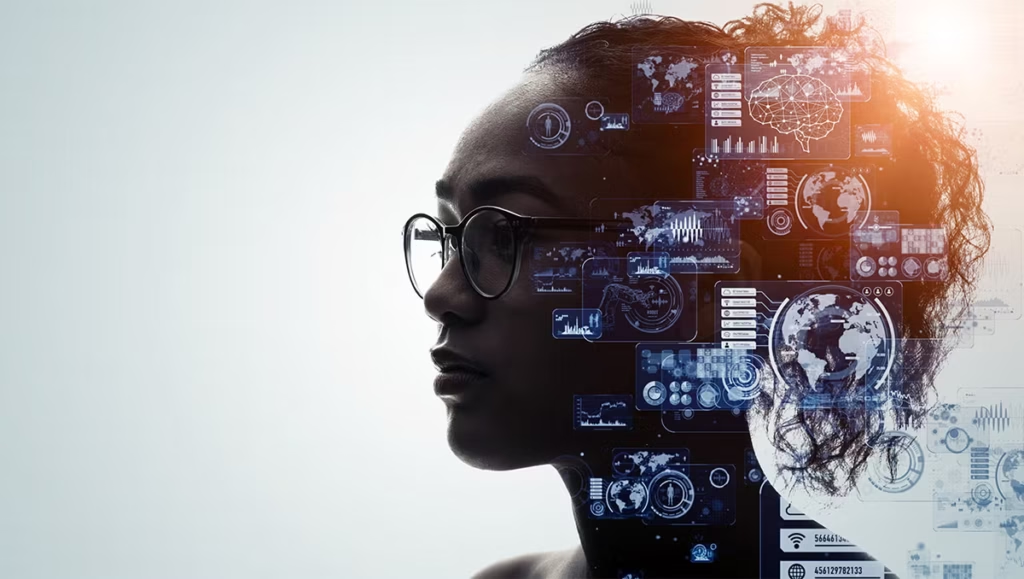
Artificial intelligence has already transformed the way people search for information, create content, automate business operations, and communicate with technology. Yet many experts believe the next major breakthrough will not come from software alone. Instead, it may emerge from combining artificial intelligence with one of the most complex systems known to science—the human brain.
Researchers across the world are exploring how brain activity can interact directly with intelligent machines. This growing field combines neuroscience, engineering, robotics, and AI to create systems that understand human intentions through brain signals. Although much of this work is still experimental, progress over the past decade has increased interest in what many call the next frontier of human–machine interaction.
What Are Brain Waves?
Brain waves are patterns of electrical activity produced when billions of neurons communicate with one another. These signals vary depending on what a person is doing, such as concentrating, relaxing, sleeping, solving a problem, or responding to the surrounding environment.
Scientists can measure these electrical patterns using specialized equipment. By analyzing changes in brain activity, researchers can study attention, memory, movement, and many other cognitive processes. Advances in computing have made it possible to process these signals faster and more accurately than ever before.
Understanding brain waves is essential because they provide a window into how the brain processes information and controls the body.
Understanding Physical AI
Most people are familiar with AI software that answers questions or generates images. Physical AI goes a step further by enabling intelligent machines to interact with the real world.
Examples include autonomous robots, smart manufacturing systems, warehouse automation, self-driving technologies, robotic assistants, and advanced medical devices. Unlike traditional software, physical AI must continuously interpret information from cameras, sensors, microphones, and other devices while making decisions in changing environments.
This combination of perception, reasoning, and movement allows physical AI systems to perform tasks that once required direct human control.
Connecting the Brain to Intelligent Machines
One of the most exciting areas of research involves Brain-Computer Interfaces (BCIs). These systems are designed to interpret certain brain signals and translate them into commands that computers or machines can understand.
In practical terms, this could allow a person to control a robotic arm, navigate a wheelchair, or interact with digital devices using brain activity instead of traditional input methods such as keyboards or touchscreens.
Modern AI algorithms play a crucial role in this process. Brain signals are extremely complex and often contain noise, making them difficult to interpret. Machine learning models help identify meaningful patterns, improving the speed and accuracy of these systems.
Although today’s BCIs remain limited in many situations, ongoing research continues to improve their reliability and usability.
Potential Applications in Healthcare
Healthcare is expected to benefit significantly from combining brain waves with physical AI.
Researchers are studying technologies that may help people with paralysis communicate more easily or control assistive devices through brain signals. Robotic rehabilitation systems could adapt to a patient’s progress, providing more personalized support during recovery.
Scientists are also exploring AI-assisted tools that analyze neurological activity to support medical research and improve understanding of certain brain-related conditions. While these technologies continue to evolve, they demonstrate the potential of combining neuroscience with intelligent machines.
Smarter Robots Through Human Intent
Traditional robots follow programmed instructions. Future robots may become more responsive by recognizing human intentions through multiple forms of input, including voice, gestures, environmental data, and, in specialized settings, certain brain signals.
Imagine an industrial robot that adjusts its actions after detecting that a trained operator intends to change a task, or a robotic assistant that works alongside healthcare professionals by responding more naturally to human interaction. These possibilities remain areas of active research, but they illustrate why interest in physical AI continues to grow.
Challenges That Researchers Must Solve
Despite rapid progress, several challenges remain before brain-wave-driven AI becomes widely available.
Brain signals differ from one person to another and can change over time. Collecting high-quality data without interference is technically demanding. Researchers also need systems that are accurate, reliable, and practical for everyday use.
Privacy is another important consideration. Brain-related information is highly personal, so developers and policymakers continue discussing appropriate safeguards for data protection, informed consent, and responsible use.
These technical and ethical questions will shape how future brain-computer technologies are designed and deployed.
Conclusion
Brain waves and physical AI represent one of the most exciting frontiers in modern technology. By combining advances in neuroscience with artificial intelligence and robotics, researchers are exploring new ways for humans and machines to interact more naturally and effectively.
Although many applications are still in development, the progress made so far demonstrates significant potential across healthcare, robotics, manufacturing, accessibility, and scientific research. At the same time, important challenges related to privacy, security, ethics, and reliability must continue to be addressed.
Rather than replacing human intelligence, physical AI supported by insights from brain activity is more likely to expand human capabilities and create new tools that improve quality of life and productivity. As research continues, the relationship between people and intelligent machines is expected to become more collaborative, opening the door to innovations that could reshape industries and everyday experiences in the years ahead.